| Who was “Pocela” ?
 The library in Pocklington is named the “Pocela Centre”, but why is it so named? The library in Pocklington is named the “Pocela Centre”, but why is it so named?
The Survey of English Place-Names, a British Academy Research Project, is one of the longest-running projects of its kind. It states that the place name of Pocklington derives from the 'farm of Pocela's people', from the old English name of Pocela plus ”ing“ meaning 'his followers' plus “ton” the old English word for settlement.
The Domesday survey of 1086 records the name as ‘Poclinton’. Many other variants are prevalent in early documents; Poklington, Poklyngton, Pochelinton, Pokelinton, Pokelynton, Pokelintun, Pokelyngton, Pokelington, Pockelington, Pocalinton, Poglynton, Poghelington, Puk(e)linton. Most of these spellings date between the 11th to 16th centuries, but all are based around the same name we have today.
Pocela would have been described as a thegn or thane who was an aristocrat who ranked at the third level in lay society, below the king and ealdormen (known today as Aldermen). He had to be a substantial landowner. Thanage refers to the tenure by which lands were held by a thane as well as the rank; an approximately equivalent modern title may be that of baron.
The term thane was also used in early medieval Scandinavia for a class of retainers, and thane was a title given to local royal officials in medieval eastern Scotland, equivalent in rank to the child of an earl.
When the Roman rulers left there would be a lack of ruling structure and instability would have caused famine and other societal disruptions that may have increased violence and led previously independent farmers to submit to the rule of strong lords. The Old English word for lord is hlaford ('loaf-guardian' or 'bread-giver').
It is likely that the missionary Paulinus established the first Christian church in Pocklington on his way from Goodmanham to found York Minster. Certainly, the Sotheby Cross, dating from the late 14th century in the churchyard at All Saints' Church, has the inscription "Paulinus here preached and celebrated AD627".
The back of All Saints‘ Church has the town beck running close by, and probably the location where the early residents were baptised by Paulinus. The church itself is on a raised mound, which was where the first, possibly wooden church, would have been built. The wooden or early stone Anglo Saxon building being later replaced by the Norman stone edifice we see today. The raised mound (ancient burial mound??) on which the church was built has saved the building from past flooding which has afflicted the town for centuries, until the problem was fixed in recent times.
Pocela probably lived around 600-650 A.D. and may have been converted to Christianity by Paulinus, but we will never know. Pocklington as a named settlement with church seems to originate from around this time.
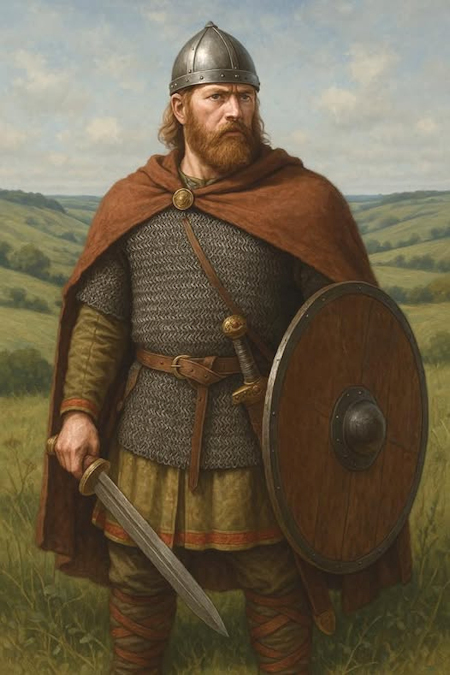
Image: An AI depiction of Pocela
|