|
The Dickens link to Pocklington and Malton
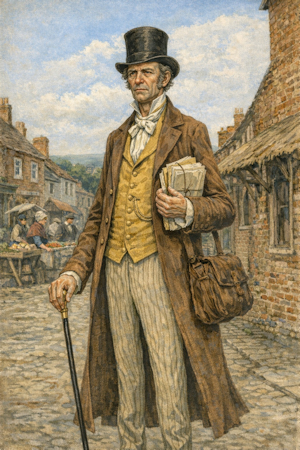 RICHARD CHICKEN was an interesting character and was born in York on the 6th August 1799. He spent some of his early life in Pocklington with his grandparents, which local resident stories suggests was at Brass Castle Hill. His mother was Elizabeth Huddleston of Pocklington, the daughter of Richard Huddleston, who was the steward to the Denison's of Kilnwick Percy. She married Nicholas Chicken in Pocklington church in 1798, and produced Richard their only son, the following year. Nicholas came from Blades in County Durham and was a wine merchant in partnership with William Harrison of Harrison & Co. of Low Ousegate. RICHARD CHICKEN was an interesting character and was born in York on the 6th August 1799. He spent some of his early life in Pocklington with his grandparents, which local resident stories suggests was at Brass Castle Hill. His mother was Elizabeth Huddleston of Pocklington, the daughter of Richard Huddleston, who was the steward to the Denison's of Kilnwick Percy. She married Nicholas Chicken in Pocklington church in 1798, and produced Richard their only son, the following year. Nicholas came from Blades in County Durham and was a wine merchant in partnership with William Harrison of Harrison & Co. of Low Ousegate.
As an aside, Kilnwick Percy also has a wine industry connection through Sir Edmund Anderson's daughter, Elizabeth (1680-1771) who married Stephen Croft in 1711. He was from the Croft family of York, and London wine merchants from whom 'Croft Original' originated.
Richard had a colourful life as an actor, worked as an engineer on the railways, and in later life went on to become a clerk at various establishments, but ended up penniless and died in the workhouse. He married Louise Alexander and was the father of 12 children, only five of which survived. He was well known in York as an eccentric character and much evidence suggests that he was the man that Charles Dickens wrote about in 'David Copperfield' called Mr Micawber. In 1845, at the age of 22, Richard was resident engineer at Malton, supervising railway construction for the contractor, John Cass Birkinshaw. Charles Dickens found the prototype for this larger than life eccentric on one of his visits to see his younger brother, Alfred Lamert Dickens. Alfred Dickens lived at first at Hillside Cottage, Malton, but after his marriage on 16 May 1846 to Helen, the daughter of Robert Dobson, the station master at Strensall, he lived for a time in York where he was visited by his elder brother in December 1847. After Birkinshaw was appointed consulting engineer to the Malton and Driffield Junction Railway (which was authorised in 1846), the younger Dickens moved to Derwent Cottage, Norton, to be nearer to the work site and his office in the Market Place at Malton, from which he provided the local supervision for the construction and completion of the line. Charles Dickens visited his younger brother Alfred in Malton on many occasions and must have met Richard Chicken through contact via his younger brother. Richard Chicken made such an impression on the author that he immortalised him as Wilkins Micawber in ‘David Copperfield’, his favourite, and often said to be Dickens own autobiographical book. It was first published in monthly parts in 1849 and completed in the autumn of 1850.
As another aside, Dickens' association with Malton was known through his friendship with Charles Smithson a solicitor who practised in Chancery Lane. Although Charles Dickens had not penned "A Christmas Carol" in Malton, the Smithson family were told by Dickens that the office in Chancery Lane was the model for Scrooge’s Office and that the ‘Bells’ described in the novel were those of St Leonard’s Church on Church Hill.
 Chicken was described as tall, lean, and cadaverous. Deposited in the public library at Stoke Newington for safe custody are the letters of Richard Chicken, who for over thirty years was one of York’s genteel oddities, and who, like Mr. Micawber, was always ‘waiting for something to turn up’. After being educated at the Bingley Grammar School, Chicken started life equipped with a remarkable flow of eloquant language and was happily possessed of a variety of other qualifications. Elocution seems to have been his favourite subject, for after having been attached to an itinerant stock company of players connected with the theatre at Nottingham, he became a professor of that art in York. As Chicken’s movements were somewhat erratic his career is difficult to follow very closely, but after closing down as a ‘Professor of Elocution’ we know that he was for a time a clerk at the York Diocesan Registry Office. After leaving the Diocesan Registry Office and finding himself in a state of ‘financial embarrassment’ to the extent of 7s. 6d., he sent the following letter to the Lord Mayor: Chicken was described as tall, lean, and cadaverous. Deposited in the public library at Stoke Newington for safe custody are the letters of Richard Chicken, who for over thirty years was one of York’s genteel oddities, and who, like Mr. Micawber, was always ‘waiting for something to turn up’. After being educated at the Bingley Grammar School, Chicken started life equipped with a remarkable flow of eloquant language and was happily possessed of a variety of other qualifications. Elocution seems to have been his favourite subject, for after having been attached to an itinerant stock company of players connected with the theatre at Nottingham, he became a professor of that art in York. As Chicken’s movements were somewhat erratic his career is difficult to follow very closely, but after closing down as a ‘Professor of Elocution’ we know that he was for a time a clerk at the York Diocesan Registry Office. After leaving the Diocesan Registry Office and finding himself in a state of ‘financial embarrassment’ to the extent of 7s. 6d., he sent the following letter to the Lord Mayor:
"I want some employment, anything however tedious or irksome is better than dependence. Can you work me in your office occasionally to execute elecution? ‘I worship with the Methodists, and joined that body when I was with Mr. Birkinshaw. I have been attached to them from boyhood, ever since I was trained by my grandmother at Pocklington, at the time my grandfather was steward to the Denisons of Kilnwick Percy."
Richard Chicken never had enough money to support himself and his growing brood of children in the style he felt he deserved. Mr Micawber once told David Copperfield "Annual income twenty pounds, annual expenditure nineteen nineteen six, result happiness. Annual income twenty pounds, annual expenditure twenty ought and six, result misery." Sadly, Mr Micawber was never able to follow his own advice – leaving him, his wife and his large brood of children on the edge of poverty. What makes him one of the best-loved characters in English literature, however, is his endless optimism (the unshakeable conviction that something would turn up); his warm heart; his exalted opinion of himself – and his flowery language.
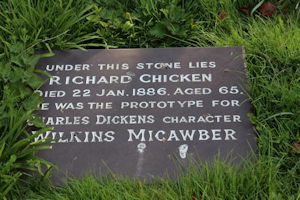
Mr Chicken died in the Union Workhouse in Huntington Road on January 22, 1866, with his long-suffering wife, Louisa, at his side. He was in his mid sixties, the father of 12 children, seven of whom died young. The grave in York Cemetery today is marked by a simple slate headstone, erected much later by a York benefactor. But it is not the children whose names are recorded on it. Instead, the name on the headstone is that of Richard Chicken, a larger-than-life York clerk of good family but diminished means which reads "Under this stone lies Richard Chicken. Died 22nd January 1886, aged 65. He was the prototype for Charles Dickens character Wilkins Micawber". Appropriately for a fabricator and rascal it records the wrong year!
Ref: https://www.maltonmuseum.co.uk/2025/12/19/charles-dickens-connection-with-malton/
https://www.sandramidgley.com/RichardChicken/index.html
|