Pocklington Church Clock
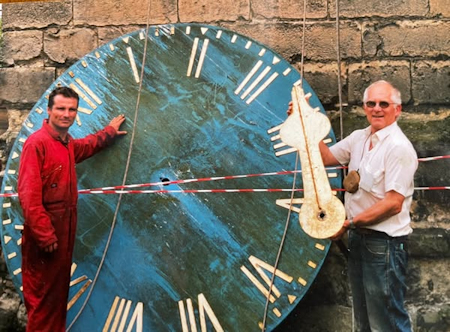 Pocklington's town clock situated on the tower of All Saints Church was manufactured in 1841 by a mechanic and clock maker called Charles Brown from Selby.
A restoration committee was formed by the town council in 2002 to restore the church clock and raised £15,000 to repaint the dials, electrify the mechanism and bring back the quarter hour chime. The committee's fundraising efforts were helped by donations from the town's residents and two national funds, the WREN organisation, the administrator for the landfill tax credit scheme, and the Local Heritage Initiative. The work was completed in 2003.
The church clock has an unusual mechanism in that it uses only one train to strike the hours and chime the quarter hours. Only one other church clock with a similar mechanism is known, that of St. John's Church in Keswick, Cumbria.
The committee wanted to find out more information about the maker of the clock and made an appeal for information through the local newspaper. Mel Doran a retired clockmaker who was living at Fangfoss contacted the committee with important information. He produced a copy of Loomes 'Yorkshire Clockmakers' which contains the following passage:
Brown, Charles
Selby 1834 -1846
Turret clockmaker at Finkle Street 1834 - 1846. Advert of 1846 reads:
 "Charles Brown, Turret Clock and Chime Maker, etc. Finkle Street, Selby.
Feels it is his duty to return his grateful thanks for the continued patronage he has received during the last ten years, and has much pleasure in announcing to the public that he has invented a double escapement turret clock which measures accurate time and capable of working hands for any number of dials of any size and cannot be acted upon by irregular motion of the atmosphere.
Its excellence and durability may fearlessly challenge competition".

"A specimen, which has been going upwards of three years, maybe seen in Selby Church".
Records show £208.11s 2d was paid to Charles Brown for the clock. (The equivalent of £12,324 today). Charles Brown had been making turret clocks for twelve years from premises in Finkle Street and was highly regarded for his engineering skills.
Unfortunately Charles Brown together with his wife & child tragically died of Cholera in an epidemic which hit the town in 1848 when over 100 people died. A special mass burial plot was used adjacent to Selby Abbey and is commemorated with a recently erected plaque.
 The committee wanted to trace other clocks made by Charles Brown to find out more about his work and thus provide interesting background information.
Another Charles Brown clock was traced to Riccall church and there is another at Crowle in Lincolnshire. An enquiry at Selby Abbey revealed they had a Smith of Derby clock which had been fitted in 1909. So where had the Charles Brown clock gone - was it now at Pocklington? At first historians at Selby said this was not so because the Brown clock had been sold to Cawood Church.
Enquiries there however revealed this to be a single faced Potts of Leeds clock. Mel Doran made an examination of Pocklington’s Charles Brown clock and found the escapement had been changed from the original. He felt because of this and the size and grandure of the clock it was likely to be the one first fitted to Selby Abbey. In 1902 the upper portion of Selby Abbey's tower had been removed because of subsidence problems and a Potts of Leeds Clock installed, with the earlier clock being sold to Pocklington. (This clock was thought destroyed in a fire at the Abbey in 1906 being subsequently replaced by the current Smith of Derby clock installed in 1909).
Church records at the Borthwick Institute in York have been examined but no record of the sale of the clock to Pocklington can be found.